Mathematical figures in the 17th and 18th centuries
Le mercredi 13 mai 2026, de 14h à 17h, nous avons le plaisir de vous convier à une séance du séminaire d'histoire des sciences mathématiques consacrées aux figures mathématiques aux XVIIe et XVIIIe siècle. Nous avons le plaisir d'entendre les exposés de Yelda Nasifoglu (University of Cambridge) et Nicolas Joannes (IMJ-PRG, Sorbonne Université).
-
Le 13 Mai. 2026
-
14:00 - 17:00
-
Séminaire
-
IMJ-PRG, Sorbonne Université, Campus Pierre et Marie Curie, 4 place Jussieu 75005 Paris
salle 15-16 413
-
David Aubin
-
0144274118
Abstracts
Yelda Nasifoglu (University of Cambridge)
From reading by drawing to illustrating analytical geometry: the changing nature of mathematical diagrams in the 17th century
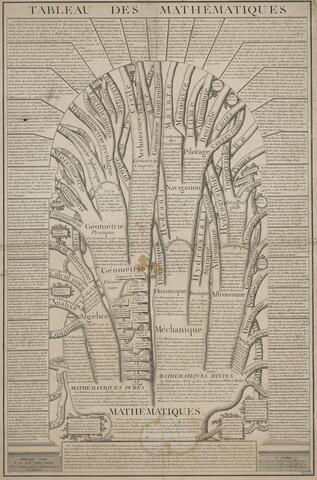
Euclid's Elements of Geometry is one of the few classical texts to have been handed down with diagrams. Rather than static illustrations, however, the diagrams were integral to the text and served as maps to the step-by-step construction of the propositions, and one read geometry manually with compass and rule in hand. While 17th-century iconography continued to suggest that reading, studying, and producing geometry were mediated through drawing, as the boundaries between theory and practice became blurred, the status of diagrams underwent significant changes. While they could serve heuristic purposes, diagrams were now mostly treated as illustrations or representations that facilitated the reading of the mathematical text which in turn had become progressively more algebraic in nature. With analytical geometry, which had the advantage of accommodating the increasing demands for accuracy during this period, the idea of geometric construction became more abstract, obviating the need for drawing.
Dr Yelda Nasifoglu is a Post-doctoral Research Associate at the Ax:son Johnson Centre for the Study of Classical Architecture, University of Cambridge, and a Bye-Fellow of Downing College. Her research focuses on the intersections between architecture and mathematics in the early modern period, with particular emphasis on comparative practices of drawing in art, architecture, science, and mathematics. She is currently preparing an edition of the earliest known English translation (c. 1670s) of Vitruvius's De architectura.
Nicolas Joannes (IMJ-PRG, Sorbonne Université)
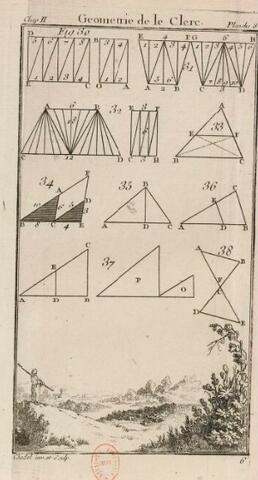
Engraving Geometry : How Engravers and Booksellers Influenced Le Clerc’s Geometrical Illustrations (1690-1835).
During the 18th century, it was not uncommon to find hundreds of figures in mathematics books. The printed production of these figures required the intervention of a number of intermediaries, starting with booksellers, draftsmen and engravers. The last ones are responsible for the final copy of the illustration, and their work is therefore of real importance in the diffusion and circulation of mathematical images. In order to study some of the ways in which this work was carried out, we will focus on illustrations produced in reprints and translations of some books, starting with the Traité de Géométrie by Sébastien Le Clerc (1637-1714). Originally illustrated with 400 engravings by the author himself, the work's wide distribution, with a dozen editions and translations between 1690 and 1835 featuring engraved figures in different configurations, makes it an interesting example of certain reproduction methods, as well as the role and knowledge mobilized by the actors involved. The study of the figures present in these different editions enables us to identify different sets of engraved supports, sometimes used for several decades, and to trace the filiation and sources of these editions. By analyzing the differences between the illustrations in these editions, we can establish a typology of modifications and their mathematical impact. Finally, the study of their distribution through filiations sheds light on certain choices made by booksellers and producers (draftsmen, engravers) and informs us about the mobilization of their mathematical knowledge during their work.
Nicolas Joannes is a PhD student in history of mathematics at the IMJ-PRG (Institut de Mathématiques de Jussieu - Paris Rive Gauche), part of Sorbonne Université (Paris). His thesis, taking part of the ANR VHS (computer Vision and Historical analysis of Scientific illustration circulation), looks at the production and circulation of mathematical illustrations in the eighteenth century, and the role and relationships between the various actors involved (scholars, booksellers, illustrators, engravers, etc.).
IMJ-PRG
IMJ-PRG, Sorbonne Université, Campus Pierre et Marie Curie, 4 place Jussieu 75005 Paris, salle 15-16 413